
When the Environment Changes — Update (March 30)
Reinforced.

It has been five days since the last note (here it is), and at the time the question was simple…
Has the environment actually changed, or are we just reacting to short-term pressure?
That distinction matters, because temporary stress fades while structural shifts persist.
Over the past week, nothing has faded. The same forces are still in place, and they have not weakened.
If anything, they have become more obvious.
The headlines have not provided clarity.
On March 23, Trump said that talks with Iran were going well, suggesting progress and a possible path toward easing tensions. Iran denied it almost immediately, rejecting the idea that any real discussions were taking place. That alone would not be unusual, but the pattern continued.
Over the following days, the same sequence played out.
Progress was suggested, then rejected.
Optimism was introduced, then removed.
When messaging breaks down like this, it does not signal resolution. It signals disconnect.
At the same time, the situation on the ground has expanded.
The Houthis entered the conflict, opening another front and increasing the complexity of what was already a fragile situation. Missiles continue to be launched from multiple areas, and the conflict is no longer contained to a single region.
The U.S. response has also shifted.
Troops have been moved into position, and the discussion of ground involvement is no longer theoretical.
These are not signals of a system calming down.
They are signals of a system preparing for sustained tension.
Through all of this, one thing has remained unchanged.
Oil has stayed elevated, and the Strait of Hormuz continues to act as a point of constraint rather than relief. There has been no meaningful pullback, no indication that supply pressure is easing.
Here’s and updated chart of Brent Crude, /BZ futures:
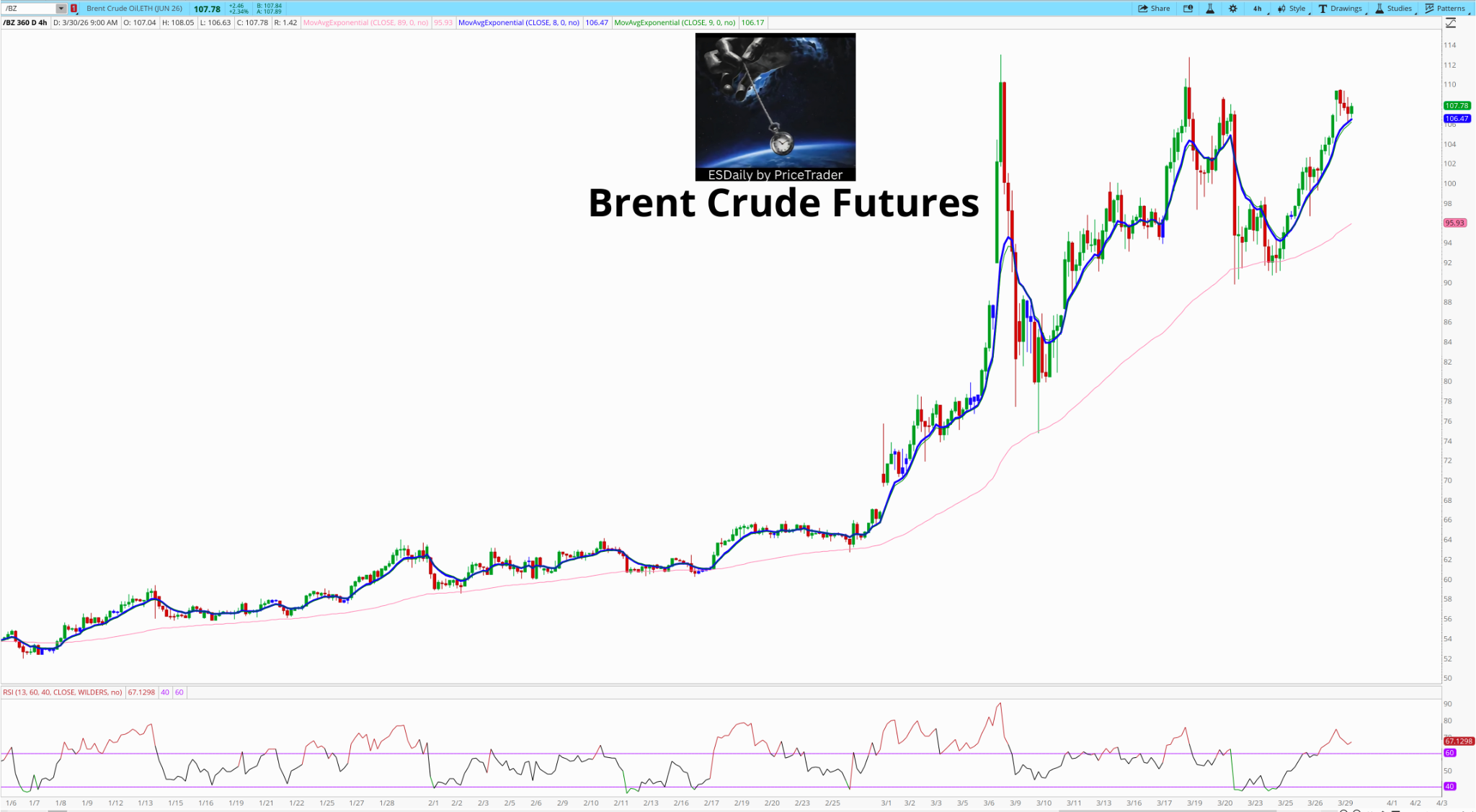
That persistence matters more than any individual headline. Markets can absorb news, but they struggle to absorb sustained pressure. When a key input remains elevated for long enough, it begins to shape behavior across everything else.
Iran’s incentives help explain why that pressure continues.
The Strait is not just a passageway, it is leverage. Control over supply translates directly into influence over global conditions. Higher oil prices do not stay contained within energy markets. They ripple outward into costs, inflation expectations, and financial conditions.
That ripple effect is already visible. Economies are tightening, and the pressure is spreading. In that environment, there is little incentive to quickly resolve the source of that leverage.
Time, in this case, works in their favor.
This brings us back to price, which is where the impact becomes clear.
Five days ago, rallies were already starting to show signs of weakness. They would push higher, but they would not extend. Follow-through was limited, and momentum would fade quickly.
That behavior has not changed. The only difference now is that it has become more consistent. Strength still appears, but it does not last. The market is moving, but it is not progressing.
On March 25th I wrote:
“If price fails to establish acceptance above 6676–6690, the recent advance is likely to be interpreted as corrective, with a return toward 6611 as the natural progression. That is the low risk shorting opportunity here.”
The 6676–6690 level was the clearest test of that shift. It was not just a resistance level, it was a decision point. Buyers needed to reclaim it, hold it, and build acceptance above it to show that control was still intact.
They failed to do that every time.
The market had already shown that it could not sustain higher prices. The downside move simply reflected that reality. It was not a new development, but a continuation of what had already been signaled.
Price is now 6450.
This is how repricing happens. Not through a single event, but through repeated failure to move in the opposite direction.
Rallies continue to behave as corrective movements, while downside moves are more direct and more decisive.
That difference in behavior has become more pronounced. Not less.
Nothing in the past week has contradicted the original thesis.
Oil remains elevated, the dollar remains firm, and financial conditions remain tight. These inputs have not changed, and price continues to reflect them through its behavior.
When the inputs persist, the outcomes tend to follow.
The question now is no longer whether the environment has changed. It has. The question is what would need to happen for that to reverse. Until something meaningfully alters the current inputs, the behavior is unlikely to shift.
And until that shift occurs, the burden of proof remains where it belongs.
On buyers to show they can take control… and hold it.
Oil Still Controls
📊 Likely Supports for March 31
High-Priority: 6400, 6331, 6265
Medium-Priority: 6484, 6141, 6027
📈 Likely Resistances for March 31
High-Priority: 6616, 6658, 6703
Medium-Priority: 6552, 6676–6690, 6742
What matters now is not just where price is, but how it got there.
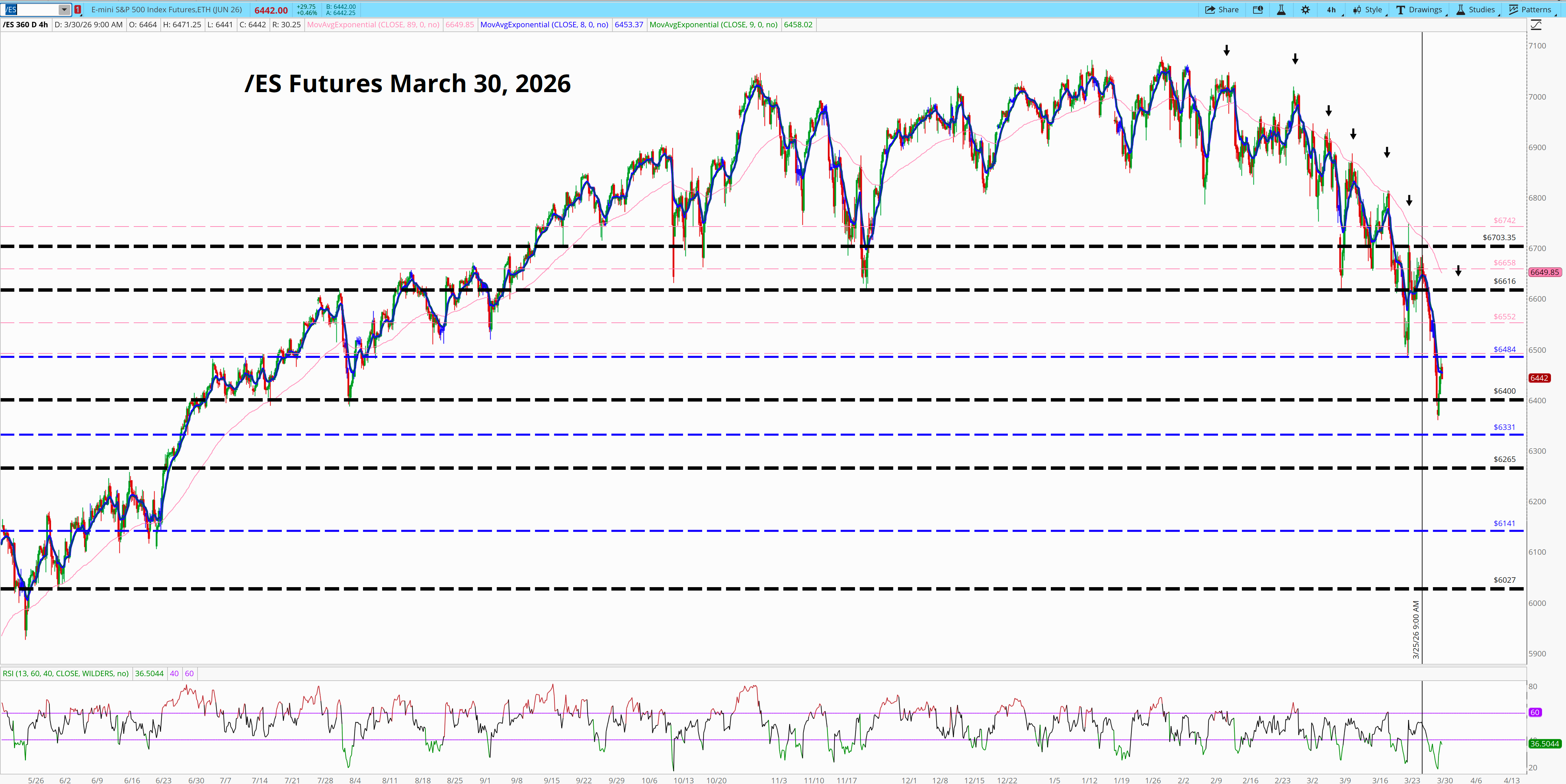
The move lower didn’t start with the breakdown. It started with repeated failure to hold higher levels. Each attempt higher stalled sooner, and each rejection came faster.
The 6616–6658 area is the last real breakdown shelf.
This is where price failed to hold structure before the move accelerated. It wasn’t lost in one move, it was lost through inability to stay above it. Once that gave, the market stopped rotating and started trending lower. Any move back into that area is a test of whether that failure still holds.
Above that, 6676–6690 remains the control level.
That was the level buyers needed to reclaim to invalidate the shift. They never did. Every push into that zone failed to hold, and each attempt weakened. As long as that level remains unclaimed, the broader structure hasn’t changed.
The shift became more visible at 6552. This is where rallies stopped behaving normally. Instead of rotating and building, they failed quickly. The market stopped giving space for continuation. That change in behavior mattered more than the level itself.
The move from 6484 into 6400 confirmed everything. Once price broke that area, there was no attempt to stabilize. The move was clean and directional. That’s what happens after multiple failed reclaims. The market doesn’t need to test again, it moves.
All of this points to the same conclusion. The market didn’t just reject higher prices. It showed, repeatedly, that it could not hold them.
For now, I’m simply waiting…
Enjoying the short, enjoying the trend.
Nothing will change here, until the chart says so.
For now, there’s no divergence across the large time frames and there are no major levels being reclaimed.
This is a time to wait…
Losers will be the ones that force things…
-PriceTrader